Restored conversion after a ~90% drop from price increases
After leading the implementation of a new monetisation strategy, I brought conversion back from a drop of about 90% as Uptime moved to full price.

Uptime helps people learn faster through 5-minute summaries of books, documentaries and podcasts, which we called Hacks. When it was time to monetise, the founders asked the Growth team, where I was the only designer, to research pricing models and put options forward. Together with the founders, we chose a model and decided to reach it in steps, starting with a heavily discounted price instead of going straight from free to full price. I then led design for the experimentation programme, working with engineers, a PM and a data analyst.
The challenge
The baseline conversion rate was strong, built on a starting price of just £9.99 a year. Over six months, the price rose three times, to £29.99, £39.99, and £59.99. Across the three increases, conversion fell by about 90%. My job was to bring it back.
As part of the growth team, I ran hundreds of experiments, from copy changes to new features. Paywall experiments brought early wins, but as the price kept rising, I focused more on getting people to use the app more often and for longer. This was product-led growth: conversion improved because people used the product more, not only because the paywall improved. Below are some of the experiments and their results.
First increase — £9.99 to £29.99
After this increase, I focused mainly on low-hanging fruit such as optimising the paywall through design and copy experiments, drawing on other products and on best practice from our partners at Apple and Google.
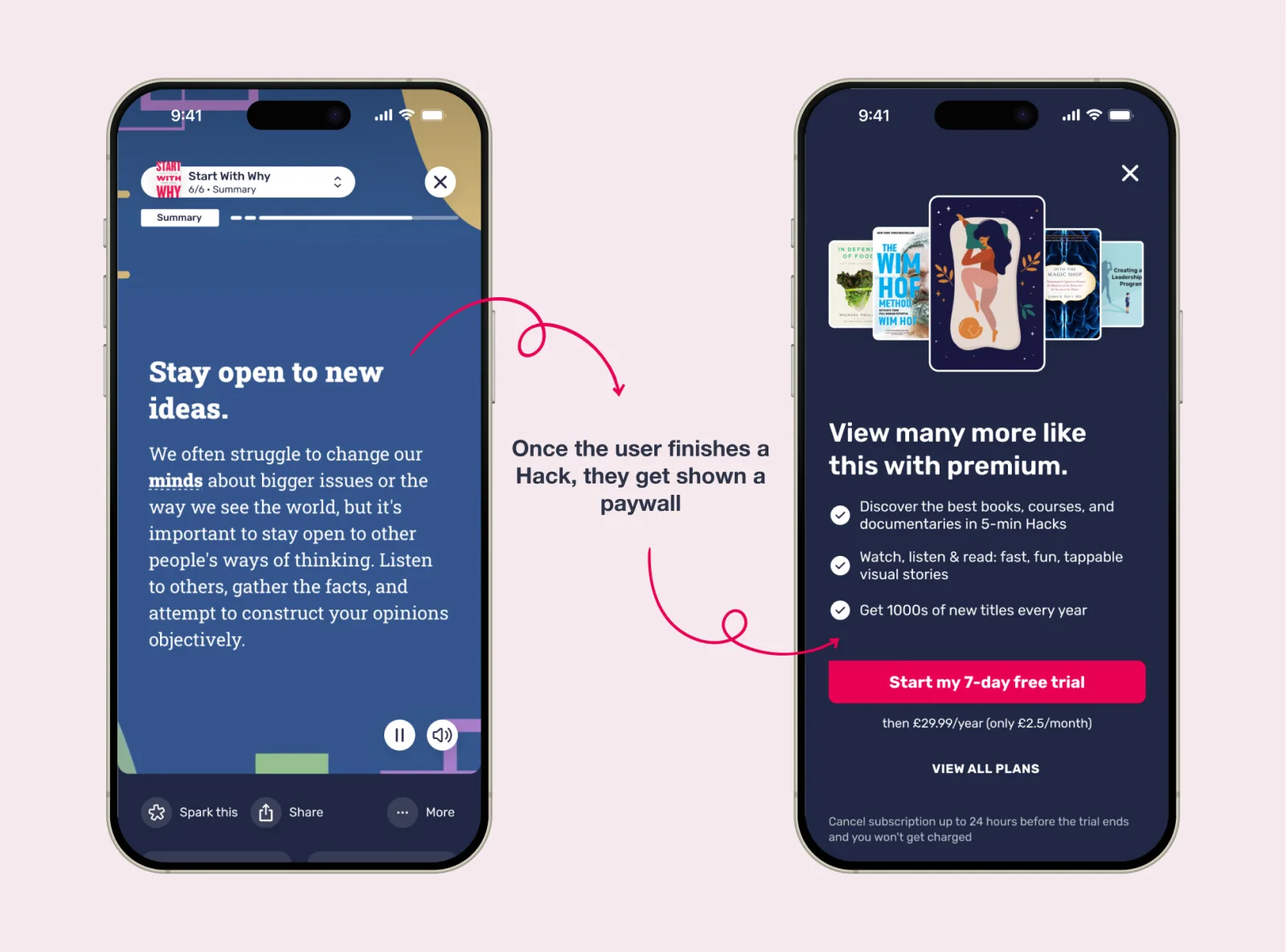
End-of-Hack paywall ✅ — Research showed that people felt they got the most value from Uptime right as they finished a Hack. My hypothesis was that this was the best moment to ask them to subscribe. Adding a paywall at the end of a Hack converted 174% more users than the control.
Gift pop-up ✅ — A surprising win came from reframing the free trial. Everyone gets 3 days free, but I tested presenting it differently. When someone dismissed the paywall, instead of letting them go into the app, we offered the same 3-day trial back as a gift: identical mechanic, different framing. Conversion rose by 125%, from both instant sign-ups and better trial-to-paid rates.
Second increase — £29.99 to £39.99
Instead of focusing only on conversion experiments, I also worked on increasing daily usage and retention, stacking new experiments on earlier successful ones.
Autoplay ✅ — The end-of-Hack paywall was converting well, so I wanted more people to reach it. Autoplay started similar content when a Hack finished, encouraging people to keep going. More finished Hacks meant more chances to show the paywall, and conversion rose by 33%.
Premium banner ❌ — Not every experiment worked. I moved the Premium banner to the top of the home page for free users, expecting more of them to upgrade due to the visibility of the call to action. Upgrades did rise slightly, but usability testing showed the banner hurt users’ trust. The small gain wasn’t worth that, so we rolled it back after a few weeks.
Third increase — £39.99 to £59.99
In this period I focused mostly on experiments higher up the funnel: getting more people to open and finish Hacks, integrating new features, and improving retention.
Spotlight ✅ — Data and usability testing showed that after onboarding, people landed on the home page without a clear idea of what to do next. I designed the Spotlight to show where to start, guiding people straight to a curated list of Hacks. Hack opens rose by 3%, which is modest given that 87% of users were already opening them. More importantly, research showed people now understood what Hacks were before opening one, instead of exploring blindly, and that set up everything further down the funnel.
Streak celebration ✅ — Research showed people were very attached to their streaks. My hypothesis was that they’d want reminders so they didn’t lose them, and so would be open to turning on notifications. I changed the streak celebration screen to ask for notification opt-in. Opt-ins rose by 686% (nope, not a typo), which improved daily retention and led to more conversions later on.
Outcome
While we did run experiments on the paywall, most of the gains came from getting more people to use the app more often, for longer. After six months, conversion was back to nearly 100% of the baseline, at six times the price.
This is a short version. Full case study available on request.